PEWTERMAKING IN PILSEN
The first written mention of pewter production dates from the fifteenth century and concerned religious ceremonial objects and tableware. However, the oldest dated objects come from the seventeenth century. The first evidence of pewterers (tankard makers) in Pilsen dates from the second half of the fifteenth century, when they were members of collective craftsmen’s guild due to their low numbers. The importance of Pilsen’s pewterers gradually rose up until the early nineteenth century, when demand for pewter ware peaked. Most pewterers had their workshops on Saská (now Rooseveltova) Street (Sachsen Gasse) and primarily worked with raw materials mined in Schlaggenwald (Horní Slavkov).
Below is a list of Pilsen’s most noted master pewterers:
MATĚJ LAUFER (+1620 Pilsen)
Probably born in Germany, Laufer was accepted to the Pilsen guild in 1586. He first opened a workshop on Saská Street, but later moved to Andělská (today’s Bezručova Street). A cauldron dating from before 1614 is believed to be one of his preserved works.
VÁCLAV HOŘEPNICKÝ (?Prague–1649 Pilsen)
One of Pilsen’s leading pewterers of the first half of the seventeenth century, he moved to Pilsen from Prague’s New Town in 1623. In 1620 he took over Laufer’s small business and workshop on Saská Street (no. 74), and took Laufer’s widow Zuzana as his wife. The most important preserved piece from his work is a pitcher for the Pilsen butchers’ guild from 1640, which is currently in the collections of the Museum of West Bohemia in Pilsen and displayed in the permanent exhibition Views into the Past of Pilsen Region – History.
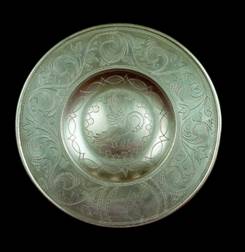
Stehlík-Čenkov baptismal font
Václav Hořepnický, Pilsen, Bohemia, 1640
(Engraving by Jan Ginter, 1660)
UMP 3396
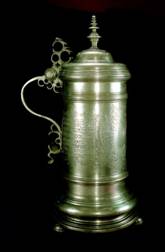
Pilsen butchers’ guild pitcher
Václav Hořepnický, Pilsen, Bohemia, 1640
UMP 19541
JOHANN GINTER (?Radnice–1666 Pilsen)
After becoming a burgher of Pilsen in 1657, in 1666 he purchased Hořepnický’s house and workshop on Saská Street, where he had probably been employed as a journeyman. His works include the decorative engraving on the baptismal font created by the workshop of Václav Hořepnický for the important Stehlík-Čenkov family of Pilsen (in the collections of the Museum of West Bohemia in Pilsen and displayed in the permanent exhibition Views into the Past of Pilsen Region – History).
JOHANN GEORG GINTER (1660–1720?)
His father was pewterer Johann Ginter, whose business he continued. Several of his decoratively engraved bowls have been preserved in the Ethnographic Collections of the Museum of West Bohemia in Pilsen.
THOMAS ADALBERT PELARGUS (1661 Mies–1743 Pilsen?)
A native of Mies (Stříbro), he moved to Pilsen in 1688 and set up a workshop on the main square. Four small pitchers for the Pilsen butchers’ guild pitcher from 1698 are preserved in the museum’s collections, and several pitchers of a practical character are preserved in other collections.
FERDINAND GÜNTZEL (?–1789 Pilsen)
A native of Silsesia, he moved to Pilsen in 1768 and had a workshop on Říšská (now Prešovská) Street. Among his preserved works is the baptismal basin in Krašovice and the millers’ guild pitcher in the collections of the Dr. Hostaš Ethnographic Museum in Klatovy.
IGNATZ GANSEL (?–1813)
Gansel worked in Pilsen from the late eighteenth century. Among the important works bearing his mark are the baptismal font in St Bartholomew’s Cathedral and the cathedral lamp with a relief of the Madonna of Pilsen. Decoratively engraved pewter inkwells are also interesting objects in the collection attributed to Gansel. Jugs and pitchers from his workshop are kept in the Ethnographic Collections of the Museum of West Bohemia in Pilsen.
JOSEF GÜNTZEL (1782 Pilsen–?)
The son of Pilsen pewterer Ferdinand Güntzl (d. 1789), whose workshop he inherited. It is believed that he later left Pilsen. A large number of smaller works have been preserved from Josef Güntzel’s workshop – jugs, tankards, pitchers, and bowls. Many of these are kept in the Ethnographic Collections of the Museum of West Bohemia in Pilsen.
JIŘÍ PLANK (?Horšovský Týn–1850?)
The last of Pilsen’s master pewterers became a burgher of Pilsen in 1840; he later married and established a workshop on the main square. While he was active, interest in pewter ware started to decline, replaced by cheaper ceramics and porcelain. (JMl)