PANTICAPAEUM
(Παντικάπαιον; now Kerch, Crimea)
According to legend, this Greek settlement was founded by one of the sons of Aeëtes, the king of Colchis. However, the truth is more complicated. As several local names of Greek origin and archaeological discoveries indicate, Greek traders and colonists from Anatolia attempted to sail their triremes across the Black Sea in as early as the eighth century BCE. They established small settlements along the shore, but they were unable to withstand the Cimmerian attacks. A second and larger wave of Greek colonisation arose in around 630 BCE and was directed towards the Cimmerian Bosporus from the Ionian city of Miletus in Anatolia. In the early fifth century BCE, the Persian incursions into Greece helped the Scythians assert their influence in cities along the northern coast of Pontus. After the final victory of Athens in the Greco-Persian Wars, Greek influence in the Bosporan Kingdom entered a new period of expansion. Booming trade with Greece ushered in rapid development in Panticapaeum, which became the capital of the newly formed Bosporan Kingdom in the mid-fifth century BCE.
As the overwhelming majority of the entire collection hails from the ancient city of Panticapaeum, the specimens provide material chronological evidence of changes in the tastes and living standards of residents in this part of the ancient world from the Archaic period (sixth century BCE) up until the Later Roman period (fifth century CE). Only a few unique pieces were purchased at antiques auctions and from private collectors. The collection contains Greek and Roman ceramic vases, glass, gold and silver jewellery, coins (currently deposited in the museum’s Numismatic Collection), bronze objects, statuettes and figurines, and Coptic textiles. The collection is of national and European significance, as nothing comparable exists outside Russia. (DB)
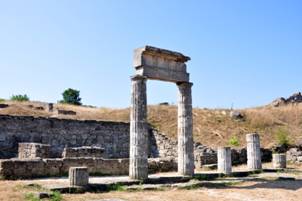
(Author: Kurgus. Source: Wikimedia Commons)