KOMÁROV
Mid-16th century First written mention of an ironworks in the Komárov region
Before 1602 Komárov ironworks is part of the Pešík estate
By 1623 Owned by the noble family Otta z Losů
By 1685 Ironworks among the assets of the Martinic family
1685 The Komárov estate comes into the possession of Count Wrbna and becomes part of the Horowitz estate (hence in later years the ironworks is described as the “Horowitz” or “Horschowitz” ironworks)
1792–1823 Count Rudolph Wrbna (1761–1823) takes over management of the ironworks. New technology is introduced, iron production is increased, and art casting is developed
1829 Participates in and wins first place at the third industrial exhibition in Prague
1831 Participates in and wins first place at the fourth industrial exhibition in Prague
1835 Participates in and wins first place at the General Austrian Trades Exhibition in Vienna
1836 Casts the Russian memorial commemorating the Battle of Kulm (1813) erected near Přestanov, a village near Teplice. Dominik Zafouk was the sculptor.
1852 The Horowitz estate and Komárov ironworks is purchased by Prince Wilhelm von Hanau-Horowitz. An ironworking school and museum were established during his tenure.
1891 Participates in the Prague Jubilee Exhibition. After the end of the exhibition, the Hanau Pavilion (Hanavský Pavilon), which originally housed the Komárov cast iron exhibit, was donated to the City of Prague. In 1895 the pavilion was relocated to Letná Park, where it remains to this day
1902 The ironworks is purchased by the Vienna-based C. T. Petzold company
1919 The Komárov ironworks becomes a joint-stock company with production focused on enamelled cast-iron tubs and rollers
1921 The last coal-fired blast furnace is shut down
1935 Takes over the production of mill machinery from Pardubice; the ironworks and foundry transforms into an engineering company
1949 The company is renamed Buzuluk Komárov
1952 Takes over production of rubber industry machinery from Svit Gottwaldov
1950s Manufacture of mill machinery returns to Pardubice; Buzuluk is made part of Západočeské strojírny a slévárny, the state-owned engineering and foundry holding based in Hořovice
1960 Launch of operations at the renovated foundry
1989 Buzuluk becomes an independent state-owned company
1992 Established as a joint-stock company
1996 Buzuluk is made part of ČGS a.s., a Czech rubber holding
2012 Buzuluk is purchased by Dalian Co Ltd. China (JMl)
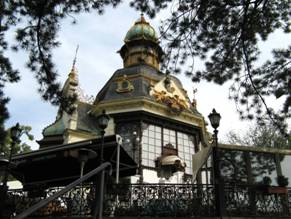
Hanau Pavilion in Prague (1891)